

The sweep shot remains one of the most valuable weapons in a batsman's arsenal, particularly on Australian pitches where variable bounce and turn can challenge even the most accomplished players. Whether you're preparing for a Sheffield Shield campaign, a weekend club match, or simply looking to add runs against spin bowling, mastering the sweep shot can transform your batting average.
This practical guide provides a structured, step-by-step approach to developing a reliable sweep shot. Designed for grassroots players, coaches, and parents working with developing cricketers, these drills build from fundamental technique through to match-realistic scenarios. By the end of this checklist, you'll have a repeatable practice routine that develops both the conventional sweep and the reverse sweep, with specific attention to the conditions you'll face on Australian decks.
What You'll Need
Before beginning these drills, ensure you have the following equipment and conditions:
- A batting net or practice wicket with a concrete or synthetic surface (grass is acceptable but less predictable for drill repetition)
- A bowling machine or a reliable feeder – ideally someone who can bowl consistent off-spin and leg-spin at variable lengths
- A set of practice stumps placed at both ends
- Protective equipment: helmet with grille, leg guards, abdominal protector, gloves, and forearm guards (the sweep exposes the body to the ball)
- Cones or markers to define your practice area
- A notebook or video recording device for self-analysis
- A qualified coach or experienced player for initial technique assessment (especially important for younger or less experienced cricketers)
Step-by-Step Sweep Shot Practice Drills
Step 1: Establish Your Base – The Grip and Stance
Before any ball is bowled, your foundation must be correct. The sweep shot demands a grip that allows wrist rotation without losing control.
- Grip: Use a standard batting grip with your top hand slightly more dominant. Your bottom hand should be relaxed, allowing the wrists to roll over during the shot. Many Australian batsmen, including Steve Smith, use a slightly looser bottom hand for sweeps.
- Stance: Take your normal guard, then widen your stance slightly – feet should be shoulder-width apart or marginally wider. Your weight should be on the balls of your feet, not the heels.
- Head position: Keep your head over your front knee throughout the shot. This is non-negotiable. If your head lifts, you'll lose sight of the ball and compromise your balance.
Drill 1B: With a bat, practice the sweep motion without a ball. Focus on the sequence: front foot forward and across, knee bending, hands leading with the top hand, bat swinging in a horizontal arc, head staying over the front knee. Perform 15 repetitions, reviewing your technique in a mirror or on video if available.
Step 2: The Front Foot Sweep – Controlled Length Bowling
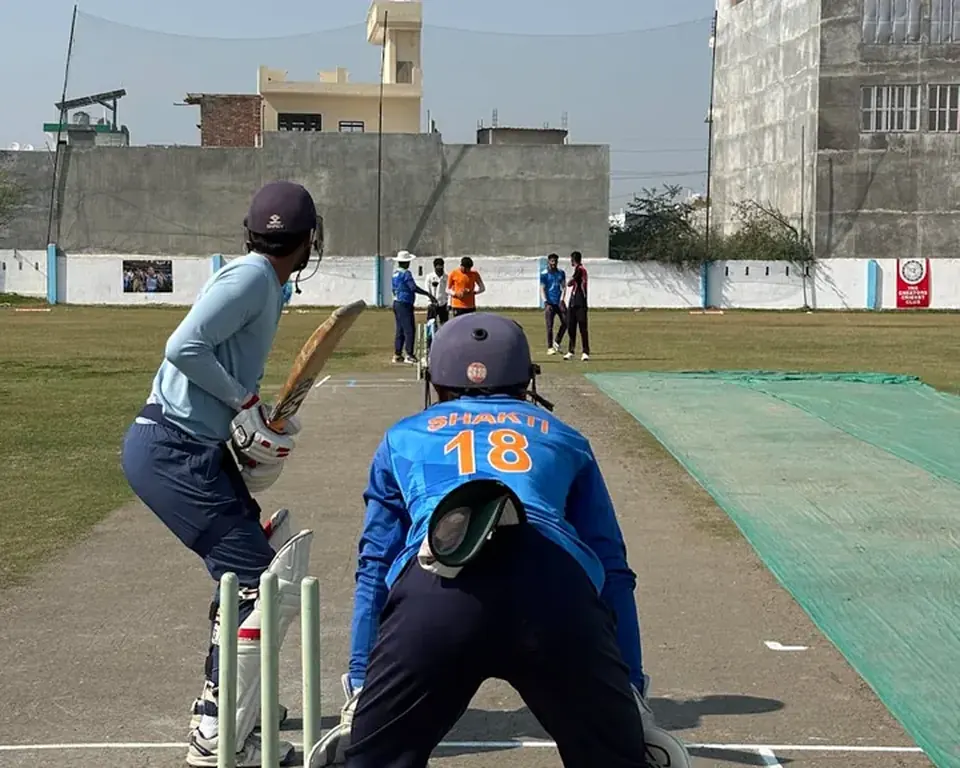
The conventional sweep played off the front foot is the foundation of all sweep variations. This drill develops your ability to judge length and execute under control.
Setup: Set cones at a good length (approximately 4-5 metres from your stumps) and a shorter length (3-4 metres). Your feeder should bowl off-spin aiming at or just outside off stump, pitching in these zones.
Execution:
- As the bowler releases, watch the ball intently. Your decision to sweep must be made before the ball pitches.
- Move your front foot forward and across to the pitch of the ball. Your front knee should bend deeply.
- Your hands should lead with the top hand, the bat swinging in a horizontal arc from outside the line of the ball.
- Contact the ball just in front of your front pad, with the bat face angled slightly downward to keep the ball on the ground.
- Follow through with your head staying still and your eyes on the contact point.
Step 3: The Back Foot Sweep – Handling Short of a Length
Australian pitches, particularly at venues like the WACA Ground or the Melbourne Cricket Ground, can produce variable bounce. The back foot sweep allows you to handle deliveries that are slightly short of a length.
Setup: Your feeder bowls at a length that is 5-6 metres from your stumps – shorter than ideal for a front foot sweep, but not short enough to cut or pull.
Execution:
- Transfer your weight onto your back foot as the ball is released.
- Your back foot moves toward the off side, opening your body slightly.
- Your front foot stays planted but takes less weight.
- The bat swing is similar to the front foot sweep, but you're now hitting the ball from a deeper position.
- Keep the ball down – this is harder from the back foot, so focus on a slightly more closed bat face.
Step 4: The Sweep Against Turn – Reading the Spin
The most challenging aspect of the sweep is adjusting for spin. A ball turning into you requires different technique than one turning away.
Setup: Your feeder bowls both off-spin (turning into a right-hander) and leg-spin (turning away). Bowl 10 of each in random order.
For off-spin (turning in) :
- Play the ball slightly later than you would against a straight delivery
- Your hands should be slightly ahead of the bat's arc
- Aim toward square leg – the spin will take the ball toward mid-wicket
- Play the ball slightly earlier, with your hands leading more aggressively
- Your bat face should be slightly more open
- Aim toward backward square leg – the spin will take the ball toward square leg
Step 5: The Reverse Sweep – Adding the Variation
The reverse sweep is a high-percentage shot when executed correctly, but it carries significant risk. This drill should only be attempted after you've mastered the conventional sweep.
Setup: Your feeder bowls full-length off-spin (turning into a right-hander) at a pace you can comfortably handle.
Execution:
- As the ball is released, pivot on your front foot, turning your body to face the off side.
- Your grip changes – the bottom hand moves to a more dominant position, or you may switch hands entirely (the switch-hit variation).
- Your bat swings from the off side toward the leg side, making contact with the ball as it passes your front pad.
- Keep your head still and your eyes on the ball throughout.
Step 6: Match Simulation – Pressure Drills
The final step brings everything together under match conditions. This drill replicates the pressure of a real innings.
Setup: Set a target – for example, 30 runs from 30 balls. Your feeder bowls a mix of lengths, lines, and spin types. You can only score using sweep shots or their variations.
Scenario variations:
- Field placement: Place fielders at square leg, backward square leg, and mid-wicket. You must avoid hitting directly to them.
- Wicket consequences: If you miss or edge a ball, you're "out" – start again from zero.
- Boundary targets: Aim to hit at least 4 boundaries in your 30-ball innings.
Pro Tips for Australian Conditions
- At the MCG and SCG: These grounds often produce lower, slower bounce. Your front foot sweep should be played with a slightly more open bat face to lift the ball over the infield. Practice hitting against the spin to find gaps.
- At the WACA Ground: The extra bounce and pace mean your back foot sweep becomes more important. Focus on keeping the ball down – hitting in the air at the WACA is particularly dangerous due to the fast outfield.
- Against quality spin in the Sheffield Shield: Watch the bowler's hand closely. Many Shield spinners, like those developing for Border-Gavaskar Trophy campaigns, have subtle variations. Your sweep decision must be made early.
- For Big Bash League and Women's Big Bash League conditions: The white ball tends to grip less, so your sweep can be played more aggressively. However, the shorter boundaries mean fielders are closer – accuracy of placement is everything.
Common Mistakes and How to Fix Them
- Head lifting: If you're missing or edging balls, your head is likely lifting. Fix: Practice the "head on knee" drill – place a cone on the ground where your front knee lands, and keep your eyes on that cone through the shot.
- Batting too early: If you're sweeping balls that are too short or too wide, you're committing too early. Fix: Delay your decision until the ball is in the air. Only commit when you see the length.
- Not using your bottom hand: A weak bottom hand reduces power and control. Fix: Squeeze a tennis ball in your bottom hand during the shot to build muscle memory.
- Playing across the line: If you're hitting the ball in the air to mid-on or mid-off, your bat is swinging across the line. Fix: Focus on hitting the ball from outside the line of off stump, using the spin to bring the ball into your hitting zone.
Checklist Summary
Use this checklist before, during, and after each practice session to ensure you're developing a reliable sweep shot:
- Foundation check: Grip is correct, stance is wide, head position is forward
- Front foot sweep drill: 20 deliveries at good length, 20 at short length – 80% kept on ground
- Back foot sweep drill: 20 deliveries at short of a length – focus on keeping ball down
- Reading spin drill: 20 deliveries in random order – call "in" or "away" before executing
- Reverse sweep drill: 10 contact attempts, 10 controlled ground shots
- Match simulation: 3 innings of 30 balls each – record scores and wicket situations
- Video review: Record your session and review technique with a coach or experienced player
- Injury check: No pain in wrists, knees, or lower back – if discomfort persists, seek professional advice
Integrating Sweep Practice into Your Wider Training
The sweep shot should not exist in isolation. For comprehensive development, pair these drills with:
- Video analysis at `/video-analysis-tips` – review your technique against international players like Steve Smith or David Warner, who use the sweep effectively in Test cricket and Ashes series.
- Coaching tactics at `/coaching-tactics` – learn how to set fields for sweep shots and how to counter quality spin bowling in the Sheffield Shield or Border-Gavaskar Trophy.
- General tactics and training at `/tactics-training` – build a complete batting game plan that incorporates your developing sweep shot alongside other scoring options.
Reader Comments (0)